

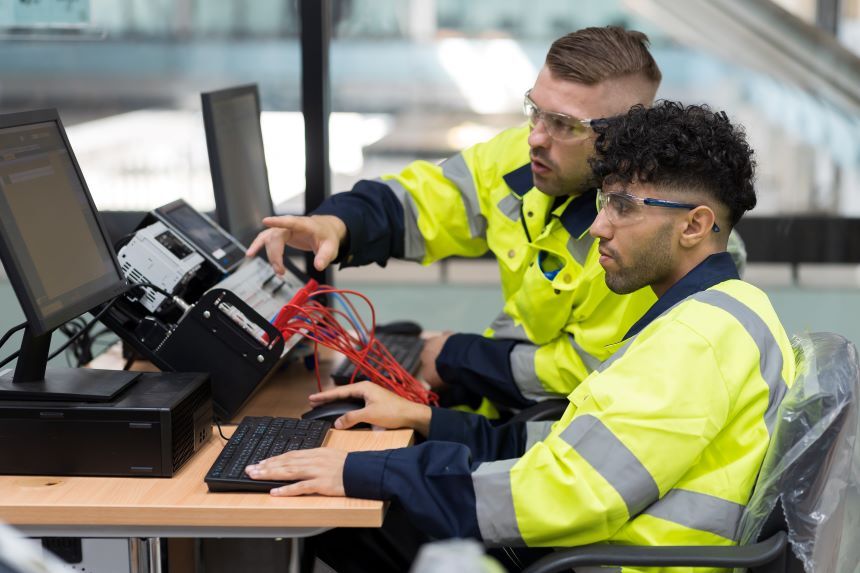
Companies must train their teams quickly, effectively, and with a high degree of personalization in the corporate landscape of 2025. Corporate training simulations have become one of the most powerful methods to develop both technical and soft skills, reduce errors, and improve knowledge retention.
Specialised platforms like Game Strategies have taken this technique to the next level, combining simulations with gamification to deliver immersive experiences tailored to each employee’s profile, supported by precise impact metrics.
What exactly is a corporate training simulation? Definition and pedagogical principles
A corporate training simulation is a virtual or physical recreation of a real workplace scenario where employees can practise, make decisions, and learn from the consequences without real risks.
It is based on pedagogical principles like Kolb’s experiential learning model, which emphasizes the importance of direct practice and subsequent reflection to consolidate knowledge.
Why simulations help students learn faster Learning by doing: effective experiential learning
Simulations allow participants to learn by doing. By experiencing the consequences in a safe environment, learning consolidates faster and transfers more effectively to the real job.
Higher motivation, autonomy, and reflection
Simulated environments create strong engagement by presenting realistic challenges, encouraging autonomy, and prompting reflection on decision-making.
Stages of implementation in the Game Strategies model
1. Diagnosis of key business competencies
Before designing any simulation, Game Strategies conducts an in-depth analysis of the competencies that determine business success. This involves identifying the essential skills for each role—such as negotiation in sales, incident resolution in customer service, or leadership in middle management—and mapping knowledge gaps.
A competency map with clear priorities is created as a result of the diagnosis. It shows how each competency relates to strategic business goals and what needs to be strengthened immediately and in the medium term.
2. Design of immersive customised simulations
Once business needs are identified, tailored simulations are designed to reflect the company’s reality. These simulations include narratives, scenarios, and challenges that place employees in daily or critical work situations.
The design can incorporate virtual or augmented reality, recreating work environments with high realism—from a negotiation room to a production line, a customer service counter, or a professional kitchen. These experiences allow employees to learn by doing, ensuring knowledge retention and effective skill transfer.
3. Integration of technology and multilingualism
Simulations work well with hybrid learning platforms and corporate training systems (LMS) that are already in place. This centralises progress tracking and connects training outcomes with key business data.
Thanks to multilingual adaptation, the same programme can be deployed internationally, maintaining consistent quality and employee experience across subsidiaries, regardless of location or language.
4. Continual assessment using the Kirkpatrick model
The impact of simulations is measured from the outset and continuously. Game Strategies uses the Kirkpatrick model to evaluate four levels: Satisfaction: participants’ immediate perception of the experience.
Learning: gaining knowledge and developing skills. Application: transfer of skills to the job role.
Results: tangible improvements such as higher sales, reduced errors, or greater customer satisfaction.
This ensures not only validation of training ROI but also real-time adjustments for maximum business relevance.
